

Author: Dr. Monika (HOD, Occupational Therapy) | 20th September 2025

Author: Dr Akshay Kr Joshi (formerly Senior OT with NRF)

Sometime in 2008, a movie was made-U Me and Hum. Recently, OTT platform aired a soulful movie called Three of Us. And then there is Saiyaara, a movie that has broken all records and is being propped as the Gen X’s cult movie is so many ways… What is not really being spoken about but am sure is being felt is the fact that the movie brings forth, yet again, the thought that Early Onset Dementia (before the age of 65 years) is no longer a shadow lurking in the dark but a stark reality that needs to be taken seriously and not rubbished as a one-off phenomenon.
What is Dementia?
Dementia is a growing public health challenge in India. According to The World Health Organization (WHO), more than 55 million people have dementia worldwide, over 60% of whom live in low-and middle-income countries. Every year, there are nearly 10 million new cases. Dementia is currently the seventh leading cause of death and one of the major causes of disability and dependency among older people globally (https://www.who.int/news-room/fact-sheets/detail/dementia).
Life expectancy in India is about 67 years of age (https://data.who.int/countries/356). Typically, early signs of dementia set in after the age of 65 years with women being more affected than men. As the elderly have better access to medical facilities in urban than rural areas, the prevalence of dementia is more in the latter areas. While medical interventions can manage symptoms to some extent, Occupational Therapy (OT) plays a crucial role in dementia care by improving the quality of life (QOL) in dementia patients and their families by focusing on functional independence, engaging in cognitive enriching tasks, and caregiver support.
Understanding Dementia and Its Impact
Dementia is progressive. The neurological condition affects memory, reasoning, and the ability to perform activities of daily living (ADL). Alzheimer’s disease, vascular dementia, and Lewy body dementia are the most common types of dementia. Symptoms range from mild forgetfulness in the early stages to severe cognitive and physical impairment in advanced stages. Emotional dependence and financial challenges increase on families, as caregiving often becomes a full-time responsibility.
In India, delayed diagnosis due to lack of awareness and social stigma are the most important obstacles to care. Early signs of memory loss are shrugged off and usually attributed to normal aging. As India’s healthcare system is already overburdened and specialized care facilities are limited, dementia patients often do not receive the support they need.
How Occupational Therapy Helps Dementia Patients
The Occupational Therapy profession is grounded in seven longstanding core values: altruism, equality, freedom, justice, dignity, truth, and prudence (AOTA, 1993). Dementia care encompasses all seven core values thereby making Occupational Therapists ideal professionals to partake a significant role in the journey of an elderly person’s care with dementia. As the primary goal in dementia care is to maintain independence, activities should be tailored to address memory loss, behavioural issues, and functional limitations to facilitate meaningful engagement in order to slow down cognitive decline.
Occupational Therapy guides dementia patients while performing self-care activities that are a part of one’s daily routine. These include but are not limited to dressing, eating, grooming, and bathing. Some ways that OTs encourage individuals to retain their independence for as long as possible include breaking down complex tasks into simple steps that can be easily managed independently, using adaptive tools and assistive technology to improve efficiency.
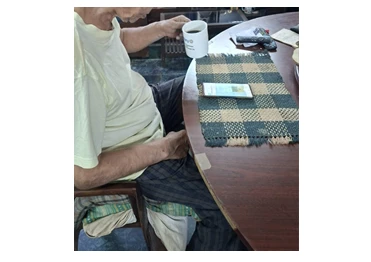
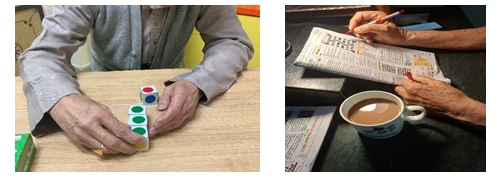
Memory-boosting techniques such as visual cues, memory books, structured schedules and activities like storytelling, music therapy, and puzzles help keep the brain stimulated. Home modifications such as decluttering spaces, improving lighting, and installing grab bars ensure a safe living environment and also go a long way to improve clarity in deciphering living spaces.
Dementia patients are prone to confusion and wandering, which can often lead to accidents. Ensuring adequate security measures by barricading and clear signages, installing alarm systems are some ways to prevent emergencies.
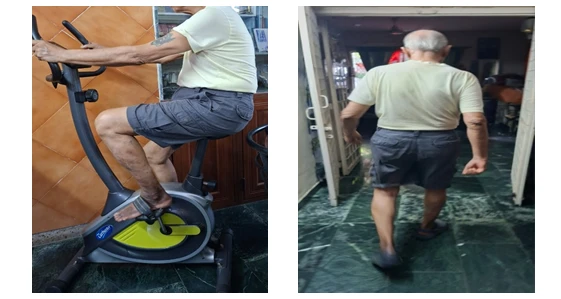
Dementia often leads to agitation, anxiety, and depression. Sensory integration techniques, relaxation exercises, scheduling and time management strategies help manage mood swings and behavioural challenges. Incorporating simple exercises like stretching, walking, and yoga into the daily routine of a person dementia can enhance mobility, reduce fall risks, and improve mood. Recreational activities that involve interaction with family members and peer groups and participating in hobbies with productive outcomes (possible in early stages of dementia) are imperative to maintain the emotional wellbeing
Empowering caregivers by educating families on effective communication strategies, behavioural management techniques, and self-care practices to prevent caregiver burnout are crucial in any chronic neurological disorder including dementia.
Why Occupational Therapy is Crucial in India
Traditionally, Indians believe in looking after the elderly at home rather than sending their loved ones to an assisted living facility or hospice care. This brings forth unique challenges in dementia care, making occupational therapy even more essential. Many parts of India, especially rural areas, lack specialized dementia care centers. Occupational therapy offers home-based interventions, making support more accessible to families who also cannot afford institutional care. With nuclear families becoming the norm, caregiving responsibilities often involve the primary caretaker which most often than not is the spouse of the patient. It is only if the partner is unable to fulfill the caregiving duties, the same is taken over by the child or paid assistance is hired. OTs set clear goals to ease the caregiving load while improving patient engagement.
The Way Forward: Expanding Occupational Therapy Services
To address India’s growing dementia crisis, the government, healthcare providers, and policymakers must work together to expand access to occupational therapy services. Some suggestions to enhance dementia by making it more accessible and affordable include:
- Dementia screening and OT interventions should be included in healthcare services especially geriatric care at government hospitals and community health centers.
- India needs more trained OT professionals specializing in dementia care. Universities and healthcare institutions should introduce specialized courses and certification programs.
- Advocacy about dementia through social media platforms, media, public awareness programs can help shift attitudes of the family in particular and community in general towards acceptance.
- Establishing caregiver support networks and adapting the environment to make it accessible to persons with dementia can provide much-needed social and emotional support to both patients and their families.
The Transformative Nature of Occupational Therapy
Occupational Therapy is indeed transformative at its core by offering practical and patient-centric interventions that enhance independence, improve safety, and support caregivers. India is set to witness a sharp slowdown in population growth in the next two decades. Although the country as a whole will enjoy the “demographic dividend” phase, some states will start transitioning to an ageing society by the 2030s ( https://www.indiabudget.gov.in/budget2019-20/economicsurvey/doc/vol1chapter/echap07_vol1.pdf). Integrating OT into the healthcare system is no longer an option—it is a necessity. With greater awareness, training, and accessibility, occupational therapy can empower individuals with dementia to lead more meaningful and dignified lives, ensuring a better future for both patients and their families.