
Author: Jhilmil Rathore (Student Volunteer) | 21st February, 2026

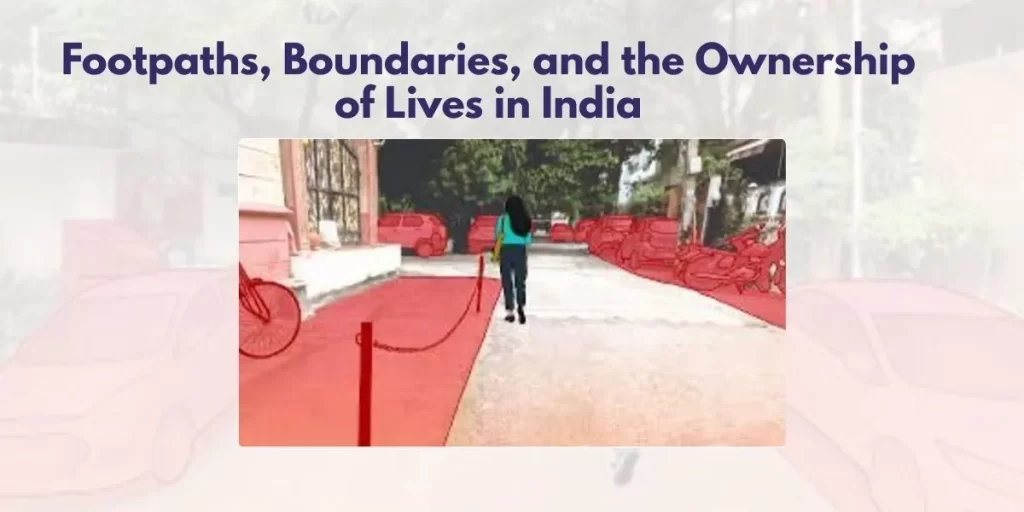
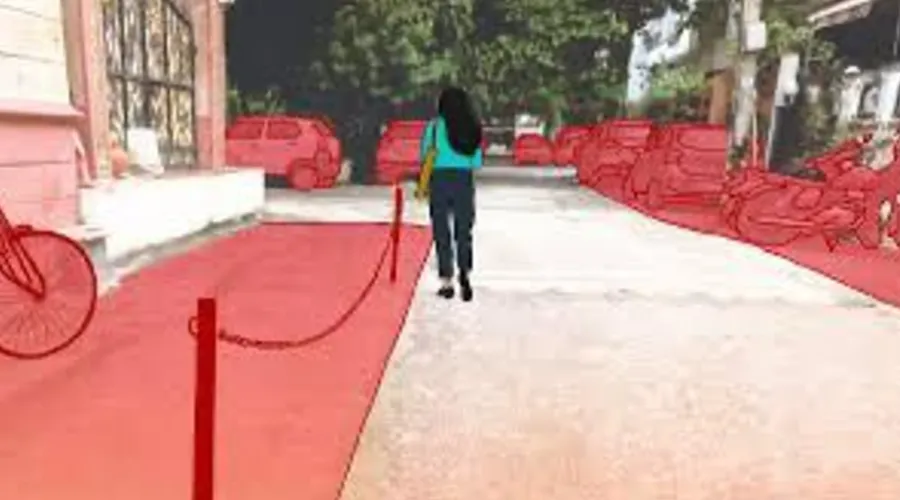
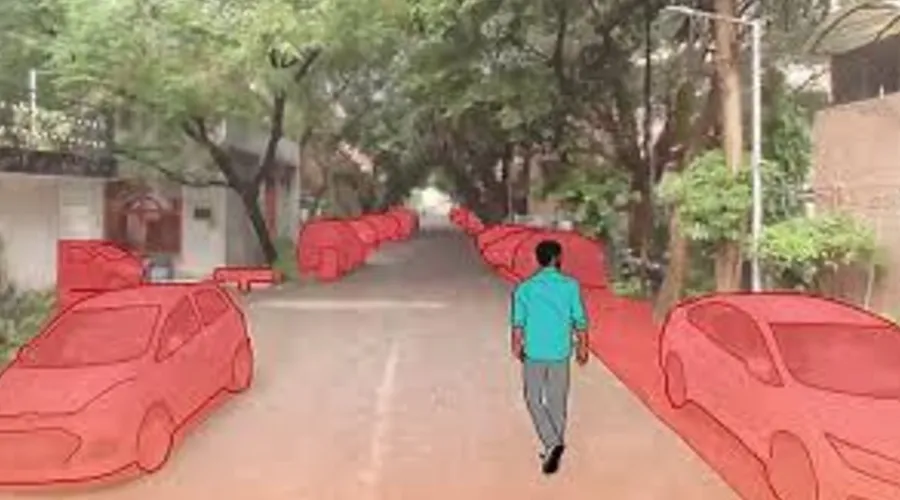
Footpaths in India are legally a pedestrian’s fundamental right (Article 226), designed for safe walking. In several investigative pieces by Newslaundry (An independent media organisation) a disturbing but familiar reality of urban India is laid bare: footpaths in residential areas—especially in so-called “posh” colonies of Delhi—are no longer public. They are barricaded, encroached upon, parked over, or absorbed into private homes as extensions of personal property. What was meant for collective use has quietly been claimed by a few, forcing pedestrians onto busy roads and directly contributing to accidents, injuries, and preventable deaths.
At first glance, this appears to be an urban planning failure or a governance issue. It is not. It is a cultural one.
Because the problem is not just about footpaths.
It is about ownership.
When Public Spaces Become Personal Property
Footpaths exist so that people can walk safely. That is their sole purpose. Yet, in many urban residential pockets, residents treat them as optional—spaces to fence off, park cars on, or redesign for aesthetic convenience. Trees are planted without thought, barricades are erected without permission, and entrances spill onto public land. The logic is simple: this is outside my house, therefore it is mine.
The consequence is equally simple: pedestrians—children, elderly people, people with disabilities—are pushed onto roads meant for vehicles. Accidents increase. Accountability disappears. And the system normalizes it.
What is striking is not that this happens—but that it is accepted.
The Same Logic Governs Indian Families
This entitlement over public space mirrors how personal lives are treated in Indian families.
In theory, an individual’s life belongs to them. In practice, it is a shared asset—co-owned by parents, grandparents, extended family, partners, and society at large. Decisions are rarely individual; they are negotiated, monitored, approved, or vetoed.
Career choices.
Marriage.
Relationships.
Having or not having children.
How one dresses, behaves, speaks, or even thinks.
The unspoken assumption is the same one applied to footpaths: your life exists in proximity to me, therefore I have a claim over it.
Co-dependency Disguised as Culture
Indian families often pride themselves on closeness, but closeness without boundaries is not connection—it is control. Emotional codependence is normalized to the point where autonomy is seen as rebellion. Independence is framed as disrespect. Privacy is interpreted as secrecy.
Children grow up learning that their choices must align with collective comfort. Adults continue living with the weight of parental approval long after they are financially and emotionally capable of standing on their own.
Love exists, yes—but so does ownership.
And just like footpaths, the individual is pushed off their own path to make room for someone else’s convenience.
From Public Roads to Personal Lives: The Cost of Encroachment
When footpaths are taken away, people get hurt physically.
When personal boundaries are taken away, people get hurt psychologically.
Anxiety, guilt, chronic self-doubt, suppressed anger, fear of disappointing others, and a fractured sense of identity are common outcomes of living a life that is constantly negotiated. Many adults do not know what they want—not because they lack desire, but because they were never allowed to develop it.
I remember this vividly from when I was in the 9th standard. One day in class, we were all talking—casually, excitedly—about what we saw ourselves doing in the future. Careers, ambitions, dreams. At that age, around 13 or 14, most of us had something to say. It did not matter whether it was realistic or not; the space to imagine existed. But there was one girl who stayed silent. When prompted, she said it very plainly, without drama or hesitation: she did not think she would be doing anything. She assumed she would be married by the time she finished school or college. When asked why she had never thought of anything else, her answer was simple—she had seen her family. She had seen her mother, her elder sisters, her cousins. That was the pattern placed in front of her. That was the life she had grown up observing, absorbing, and internalising. She was not waiting for marriage; she had merely learned not to imagine beyond it.
The harsh reality is that this may have been her choice—and it may be a life she is genuinely happy with. I do not doubt that, and I am not questioning her contentment. But what stands out is how predictably it unfolded. She was engaged while she was still in college, around nineteen or twenty, and married shortly after completing her degree. Today, she is married and roughly the same age as me. What unsettles me is not where she is now, but how early the outcome was known—how her future had been quietly sealed long before she was ever asked what she wanted. This is not just the story of a girl, or of women being denied dreams. It reflects a broader Indian reality—across genders—where many children are never given the psychological permission to dream, explore, or imagine alternatives. When imagination itself is restricted, adulthood does not arrive as a space of choice, but as a continuation of decisions already made on one’s behalf.
In both cases, the system blames the victim:
- Why were you walking on the road?
- Why can’t you adjust?
- Why are you being selfish?
The question that is never asked is: Why was the space not protected in the first place?
Boundaries Are Not Western. They Are Human.
There is a persistent myth that boundaries, individuality, and autonomy are “Western concepts” incompatible with Indian culture. This is convenient—and false.
Boundaries are not about abandonment or disrespect. They are about recognising where one person ends and another begins. A footpath does not stop you from living in a community; it allows everyone to coexist safely. Personal boundaries work the same way.
Without them, the strongest voice wins. The most powerful takes over. And the vulnerable are forced to adjust.
Reclaiming Space—Externally and Internally
The conversation about reclaiming public spaces must extend inward.
We need to ask:
- Why do we feel entitled to spaces—and lives—that are not ours?
- Why does autonomy threaten us?
- Why is obedience valued over well-being?
- Why is control mistaken for care?
Reflecting on our own families, relationships, and expectations is uncomfortable. But it is necessary.
Because a society that does not respect public footpaths will not respect personal boundaries either.
And a country that treats individual lives as community property will continue producing adults who live carefully—but never fully.
A Final Thought
Footpaths are meant for walking.
Lives are meant for living.
Both require protection.
Both require boundaries.
And neither should need permission to exist as intended.